EN
EN

Custom Encapsulated PCB Transformers for Reliable Board-Level Power Conversion
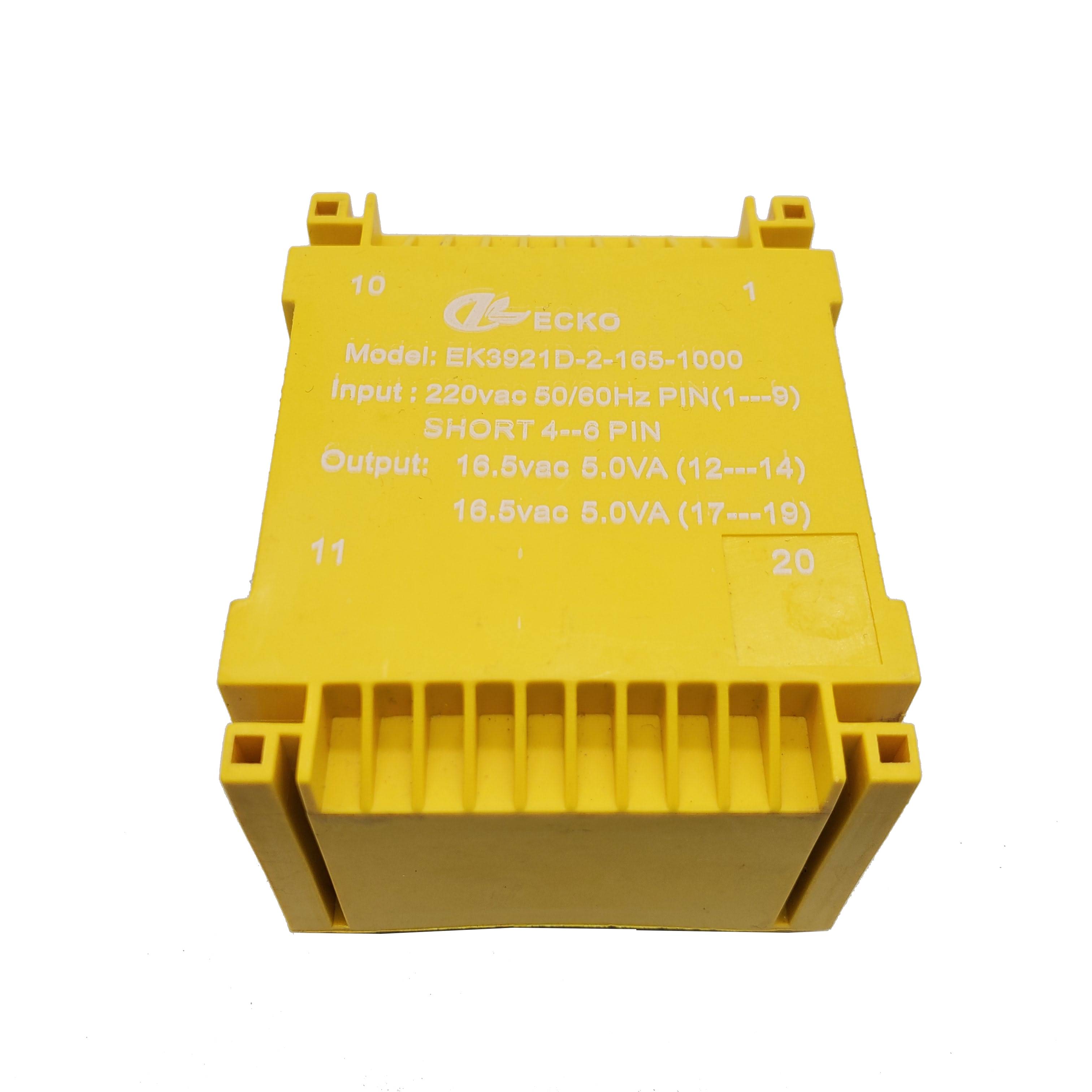
Compact, resin-encapsulated PCB transformers engineered for stable AC voltage conversion, dependable electrical isolation and repeatable through-hole assembly. ECKO customizes input and output voltage, VA rating, pin layout, dimensions, insulation system and protection features to match your circuit, enclosure and compliance requirements.
- Overview
- Recommended Products
- Input voltage range and frequency
- Required output voltage and current for every winding
- Continuous or intermittent duty
- Maximum dimensions
- PCB pin layout or footprint
- Ambient temperature and enclosure conditions
- Temperature-rise limit
- Dielectric withstand and insulation requirements
- Protection and shielding options
- Target standards and certifications
- Sample quantity and annual forecast
- Existing drawing, schematic, specification or reference sample
Encapsulated PCB Transformer Specifications
| Parameter | Typical Range / Available Options |
|---|---|
| Product Type | Low-frequency encapsulated PCB-mount transformer |
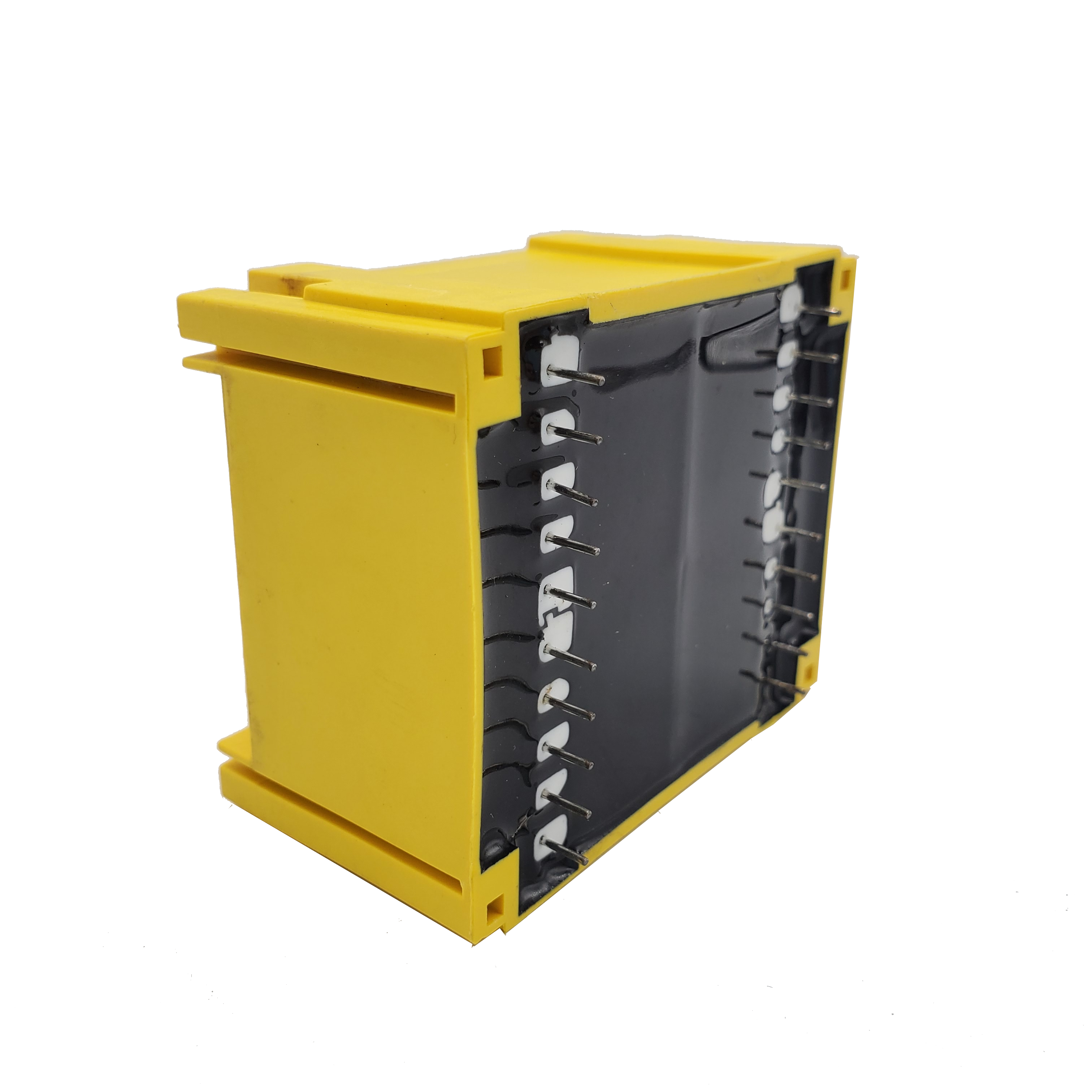
| Construction | EI laminated core, copper windings, insulated bobbin, protective enclosure and resin encapsulation |
| Rated Power | Typically 0.5 VA to 60 VA; other ratings subject to engineering review |
| Primary Voltage | 100 V, 110 V, 115 V, 120 V, 127 V, 200 V, 208 V, 220 V, 230 V or 240 V AC |
| Dual Primary Options | 2 × 115 V, 2 × 120 V or other series/parallel configurations |
| Secondary Voltage | Typically 3 V to 48 V AC; custom voltage available |
| Secondary Configuration | Single, dual, center-tapped or multiple independent windings |
| Frequency | 50 Hz, 60 Hz or 50/60 Hz |
| Output Type | Isolated AC output |
| Core Material | Laminated electrical steel selected according to power, loss and temperature-rise requirements |
| Winding Material | Specified-grade enameled copper wire |
| Dielectric Strength | Commonly designed within a 3,000–4,000 VAC range; final voltage and test duration depend on the approved insulation system and applicable standard |
| Insulation Resistance | Commonly ≥100 MΩ at 500 V DC; final acceptance criteria according to the approved specification |
| Insulation Class | Class B 130°C or Class F 155°C options |
| Temperature Rise | Defined according to rated load, ambient temperature, enclosure condition and applicable standard |
| Voltage Regulation | Optimized according to output voltage, load current, size and temperature-rise requirements |
| Encapsulation | Flame-retardant epoxy or other resin system selected according to project requirements |
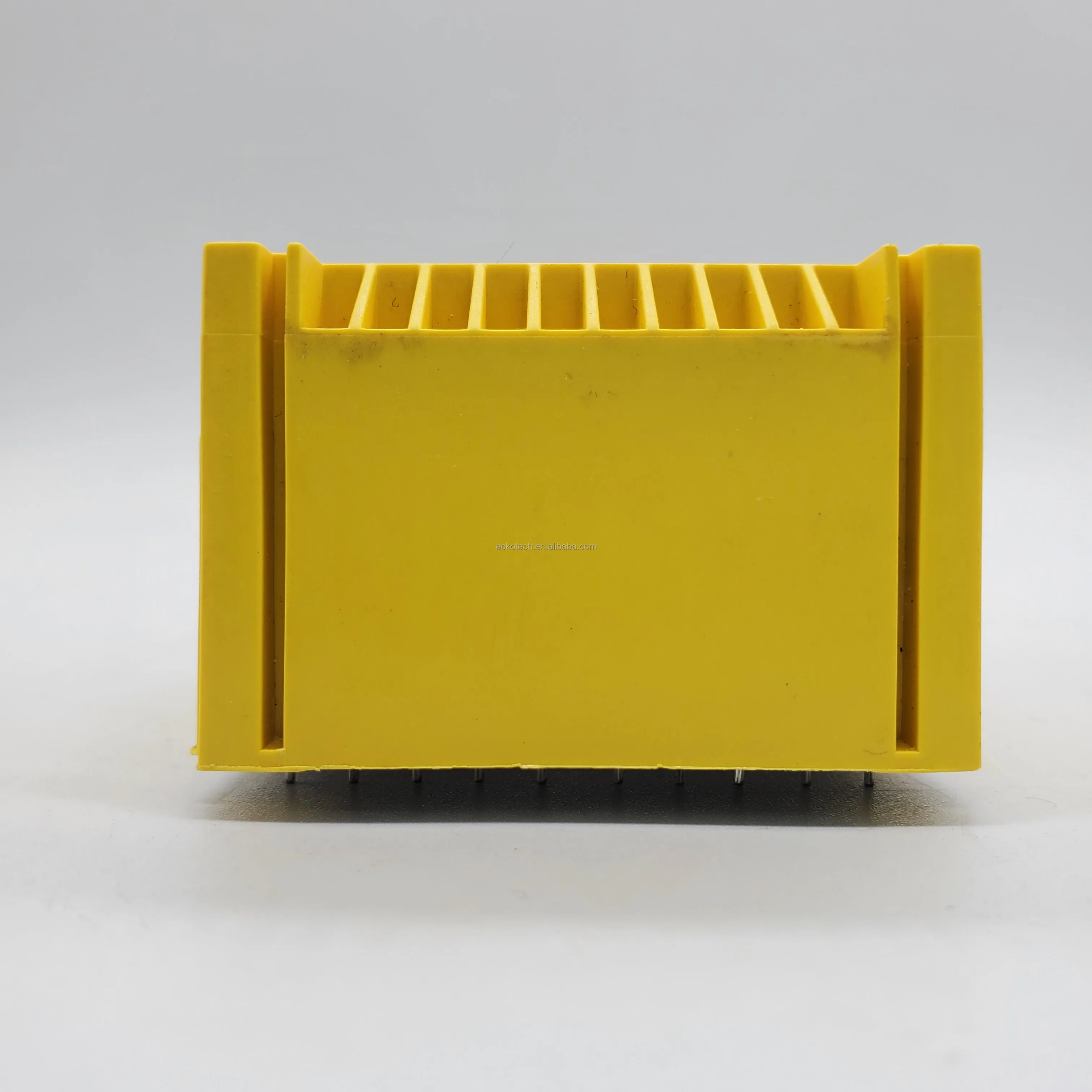
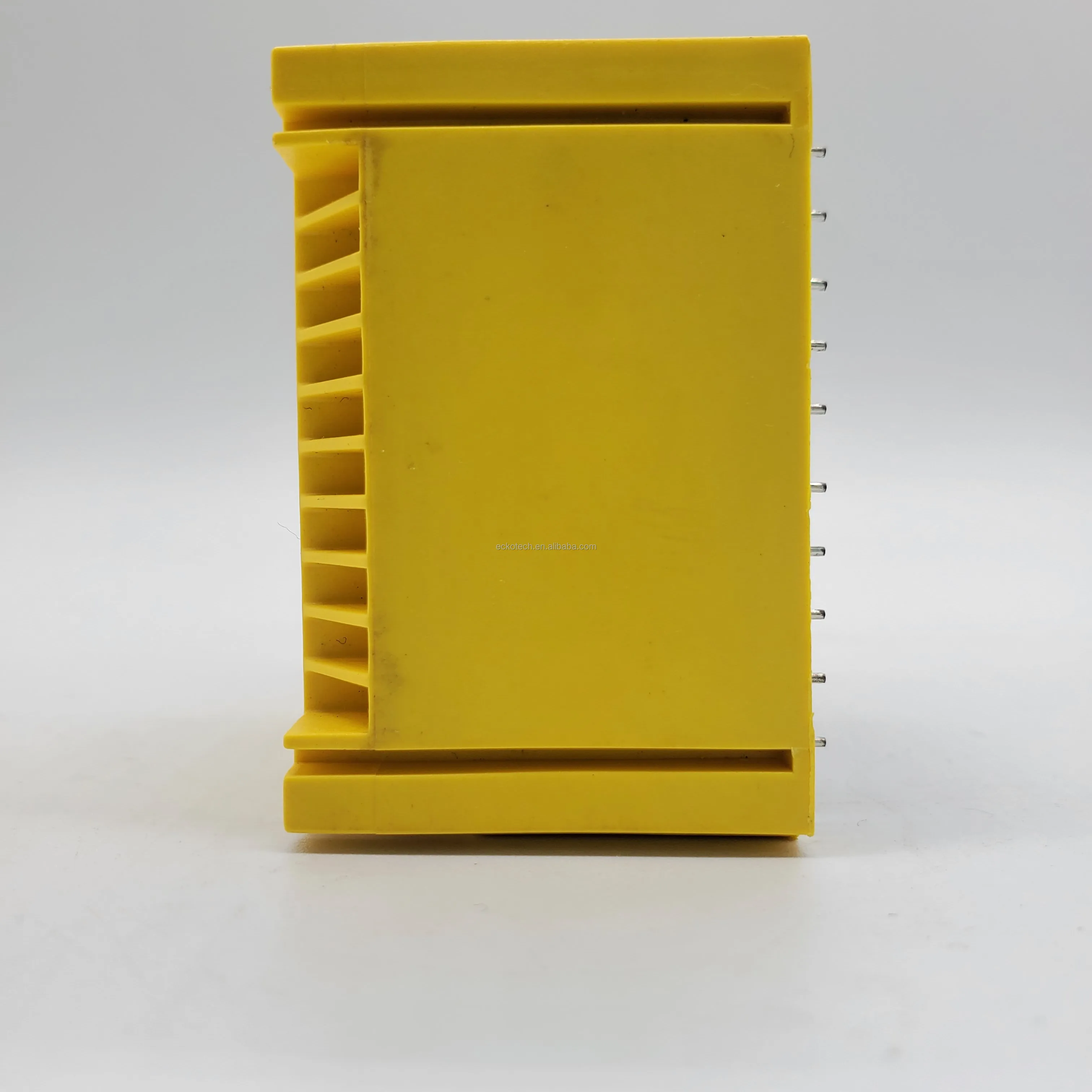
| Housing | Standard or custom molded enclosure; flame-retardant material options available |
| Mounting | Through-hole PCB mounting |
| Pin Layout | Standard or fully customized pin spacing and pin assignment |
| Protection Options | Thermal fuse, PTC protection, current-limiting design or short-circuit-resistant design where required |
| Shielding Options | Electrostatic shield between primary and secondary windings |
| Compliance Options | IEC/EN 61558, UL 5085, CE, UL/cUL, RoHS and REACH requirements, subject to model and project scope |
| Marking | Model number, electrical rating, date code, batch code, customer logo or private label |
| Packaging | Individual partitions, trays, cartons and export pallets |
The values above represent common design options rather than the guaranteed specification of every model. Final electrical ratings, dimensions, test limits and compliance requirements are defined in the ECKO-approved product specification and dimensional drawing.
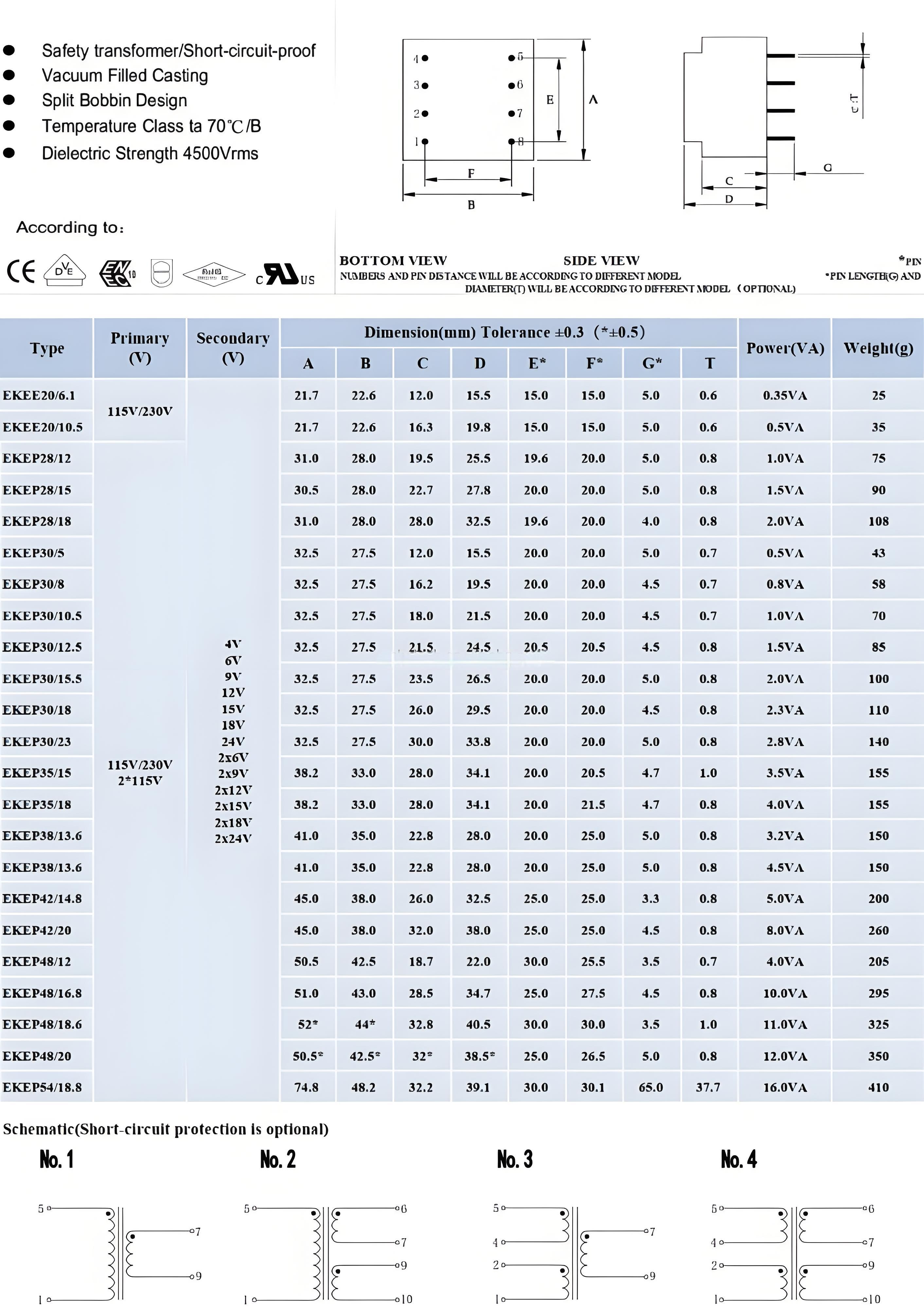
Key Advantages of ECKO Encapsulated PCB Transformers
Custom Encapsulated PCB Transformer Options
Encapsulated PCB Transformer Applications
ECKO encapsulated PCB transformer provide compact AC voltage conversion and electrical isolation for industrial, commercial and consumer electronic assemblies. Each transformer can be customized around the PCB footprint, load profile, operating temperature and safety requirements of the end product.
Why Choose ECKO as Your Encapsulated PCB Transformer Manufacturer?
Engineering Design Based on Your Actual Application
Testing Items and Acceptance Standards
| Test Item | Purpose | Inspection Frequency | Acceptance Basis |
| Visual Inspection | Checks housing, resin surface, marking, pins and workmanship | 100% | Approved appearance criteria and workmanship standard |
| Dimensions and Pin Alignment | Confirms PCB fit and mechanical tolerances | According to control plan | Approved dimensional drawing |
| Winding Continuity | Detects open circuits and termination faults | 100% | Electrical specification |
| Winding Resistance | Confirms winding consistency and connection quality | According to control plan | Approved specification and tolerance |
| Turns Ratio and Polarity | Confirms correct winding ratio and pin assignment | 100% | Approved electrical diagram |
| No-Load Output Voltage | Verifies output voltage without load | 100% | Approved test voltage and tolerance |
| No-Load Input Current | Evaluates core condition, winding consistency and losses | According to approved plan | Approved maximum limit |
| Rated-Load Output Voltage | Confirms output performance at rated current | 100% or sampling, as agreed | Approved full-load voltage tolerance |
| Voltage Regulation | Evaluates the change between no-load and rated-load output | Design validation or agreed inspection | Approved specification |
| Dielectric Withstand/Hi-Pot | Verifies insulation integrity between isolated circuits | 100% | Approved voltage, duration, leakage-current limit and applicable standard |
| Insulation Resistance | Checks resistance between isolated windings and accessible conductive parts | 100% or according to control plan | Approved test voltage and minimum resistance |
| Temperature-Rise Test | Confirms thermal performance at rated operating conditions | Sample qualification and periodic verification | Approved temperature-rise limit and applicable standard |
| Thermal Fuse Function | Verifies operation of the specified protective device | Qualification or sampling | Protective-device specification |
| Overload/Short-Circuit Test | Evaluates abnormal operating behavior where required | Design qualification | Applicable standard and approved safety requirement |
| Terminal Strength | Checks pin and termination mechanical reliability | Qualification or periodic sampling | Approved mechanical test criteria |
| Solderability | Confirms compatibility with the agreed PCB soldering process | Qualification or periodic sampling | Approved solderability criteria |
| Humidity, Thermal Cycling or Vibration | Evaluates environmental reliability when required | Customer-specific qualification | Agreed IEC 60068 method or customer standard |
| RoHS Substance Verification | Supports restricted-substance compliance | Material documentation or laboratory testing | Applicable regulatory limit and IEC 62321 test method |
Custom Encapsulated PCB Transformer Development Process
Encapsulated PCB Transformer FAQ
1. How is transformer temperature rise controlled?
Temperature rise is influenced by input voltage, frequency, core loss, copper loss, load current, ambient temperature, PCB layout, ventilation and enclosure conditions. ECKO reviews these factors during design and confirms performance through temperature-rise testing under agreed operating conditions.
2. Do you perform 100% Hi-Pot testing?
Yes. Dielectric withstand testing can be performed on every production unit according to the approved test voltage, duration and leakage-current limit. The required test parameters must match the insulation system, applicable standard and end-product safety design.
3. Can a thermal fuse be installed inside the transformer?
Yes. A non-resettable thermal fuse or other protective device can be incorporated where space, construction and compliance requirements allow. The operating temperature and protection arrangement must be selected according to the application.
4. Can you add an electrostatic shield?
Yes. A conductive shield can be installed between the primary and secondary windings to reduce capacitive coupling. The shield is normally connected to a dedicated PCB pin or lead that must be grounded correctly in the final equipment.
5. Are your transformers suitable for wave soldering?
Encapsulated PCB transformers are generally designed for through-hole assembly and can be evaluated for wave or hand soldering. The maximum solder temperature, immersion depth and exposure time should be confirmed in the approved datasheet. They should not be assumed suitable for an unrestricted SMT reflow profile.
6. Can you meet UL, CE, RoHS or REACH requirements?
ECKO can design products using appropriate insulation systems and compliant materials. Certification availability depends on the exact model, rating, construction and target market. Please specify whether you need a certified component, a design based on a particular standard or material compliance documentation only.
7. What information is required for a quotation?
Please provide:
8. What is the prototype lead time?
Prototype lead time depends on design complexity, material availability, tooling and certification requirements. ECKO confirms a project-specific sample schedule after the technical requirements and drawings have been reviewed. Expedited sampling can be discussed for urgent projects.
9. How do you control production consistency?
Production is controlled through approved drawings, BOMs, winding specifications, work instructions and electrical test limits. Material and production lot records can be maintained according to the agreed traceability requirements.
10. Can you provide inspection reports with the shipment?
Yes. Standard inspection records, Certificate of Conformity, dimensional reports, electrical test reports or customer-specific documentation can be supplied when included in the quotation and quality agreement.