EN
EN

Electrical noise and interference pose significant challenges in industrial environments, affecting equipment performance and compromising operational reliability. These unwanted electrical disturbances can originate from various sources including switching power supplies, motor drives, radio frequency emissions, and ground loops, creating a complex web of electromagnetic interference that disrupts sensitive electronic systems.
The answer to whether isolation transformers can help eliminate electrical noise and interference is definitively yes, though the extent of their effectiveness depends on the specific type of interference and the transformer's design characteristics. Isolation transformers serve as electrical barriers that can significantly reduce common-mode noise, ground loop issues, and certain types of electromagnetic interference while providing galvanic isolation between input and output circuits.
Understanding Electrical Noise and Its Impact on Systems
Common Sources of Electrical Interference
Electrical noise manifests in various forms throughout industrial and commercial environments, with each type presenting unique challenges for system designers and maintenance professionals. Switching power supplies generate high-frequency harmonics that propagate through power distribution networks, while variable frequency drives create both conducted and radiated electromagnetic interference that can affect nearby sensitive equipment.
Ground loops represent another significant source of interference, occurring when multiple grounding paths create potential differences that allow unwanted currents to flow through signal cables. Radio frequency interference from wireless communications, fluorescent lighting, and arc welding operations can couple into electrical systems through both conducted and radiated pathways, disrupting normal operation of control circuits and measurement instruments.
The Technical Nature of Noise Coupling
Electrical interference couples into systems through several mechanisms, each requiring different mitigation strategies for effective suppression. Conducted interference travels directly through power lines and signal cables, carrying unwanted frequencies that can interfere with normal circuit operation and data transmission protocols.
Common-mode noise appears as voltage differences between the entire circuit and ground reference, while differential-mode noise manifests as voltage differences between active conductors. Understanding these coupling mechanisms helps engineers determine when isolation transformers provide the most effective solution for noise reduction and system protection.
How Isolation Transformers Address Electrical Interference
Galvanic Isolation Principles
Isolation transformers achieve noise reduction through galvanic isolation, which creates a complete electrical separation between primary and secondary circuits while maintaining magnetic coupling for power transfer. This isolation breaks ground loops by eliminating direct electrical connections between input and output circuits, preventing unwanted current flow that contributes to common-mode interference.
The magnetic coupling in isolation transformers allows power transfer while blocking DC components and low-frequency noise that cannot efficiently couple across the transformer's magnetic core. This selective frequency response naturally attenuates certain types of interference while preserving the fundamental power frequency needed for equipment operation.
Common-Mode Noise Suppression
Common-mode noise suppression represents one of the primary advantages of isolation transformers in noise reduction applications. The balanced winding structure and symmetrical magnetic coupling inherently reject common-mode signals that appear equally on both input conductors, effectively filtering these unwanted components before they reach sensitive load equipment.
Electrostatic shielding between primary and secondary windings further enhances common-mode noise rejection by providing a low-impedance path to ground for high-frequency interference. This shielding must be properly connected to an effective grounding system to maximize its noise suppression capabilities while maintaining safety standards.
Types of Interference That Isolation Transformers Can Eliminate
Ground Loop Interference
Ground loop interference occurs when multiple grounding paths create circulating currents that introduce unwanted signals into sensitive circuits. Isolation transformers effectively eliminate ground loops by breaking the direct electrical connection between source and load ground references, preventing current flow through unintended paths.
This galvanic isolation is particularly valuable in systems with distributed grounding points, such as industrial control networks spanning multiple buildings or areas with different ground potentials. The isolation transformers create independent ground references for each side of the system, eliminating the potential differences that drive ground loop currents.
Power Line Transients and Spikes
Power line transients from lightning strikes, switching operations, and motor starting can damage sensitive electronic equipment and disrupt normal operation. Isolation transformers provide inherent protection against certain types of transients through their inductive impedance characteristics and limited energy transfer capability during fault conditions.
The magnetic coupling in isolation transformers naturally limits the rate of change of current and voltage, providing some degree of transient suppression. However, for comprehensive transient protection, isolation transformers are often combined with surge protective devices and proper grounding systems to achieve optimal results.
High-Frequency Electromagnetic Interference
High-frequency electromagnetic interference from switching power supplies, radio transmissions, and digital circuits can couple into power distribution systems and affect sensitive analog equipment. Isolation transformers with proper shielding and core design can significantly attenuate these high-frequency components through their frequency-dependent impedance characteristics.
The interwinding capacitance and leakage inductance of isolation transformers create natural filtering effects that reduce high-frequency noise transmission from primary to secondary circuits. Careful attention to winding techniques and core materials optimizes this filtering performance for specific frequency ranges and application requirements.
Design Factors That Enhance Noise Elimination Performance
Core Material and Construction
The core material and construction of isolation transformers significantly influence their noise suppression capabilities and overall performance characteristics. High-permeability core materials provide better magnetic coupling efficiency while maintaining lower core losses, contributing to improved signal-to-noise ratios in the output power.
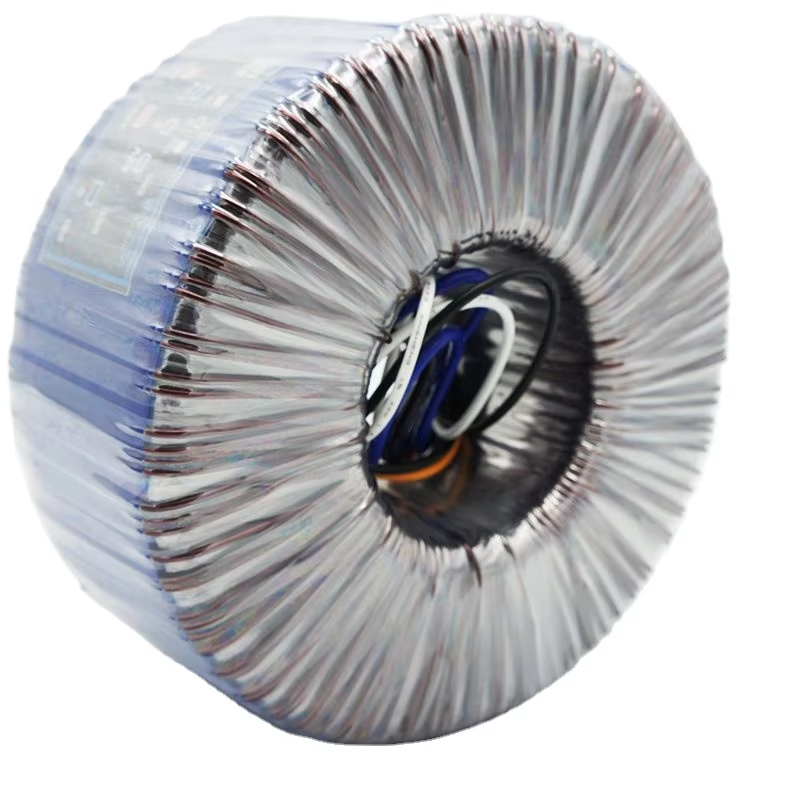
Toroidal core designs offer advantages in noise reduction applications due to their contained magnetic fields and reduced electromagnetic radiation compared to conventional laminated cores. The circular geometry minimizes external magnetic field exposure while providing excellent magnetic coupling between primary and secondary windings.
Winding Configuration and Shielding
Winding configuration plays a crucial role in determining the noise suppression effectiveness of isolation transformers. Balanced winding arrangements with careful attention to symmetry maximize common-mode noise rejection while minimizing interwinding coupling that could allow interference transmission.
Electrostatic shielding between windings provides additional noise suppression by creating a barrier against capacitive coupling of high-frequency interference. The shield connection and grounding scheme must be carefully designed to avoid creating new ground loops while maximizing noise suppression performance.
Frequency Response Characteristics
The frequency response characteristics of isolation transformers determine their effectiveness against different types of electrical interference. Low-frequency performance depends on core design and magnetizing inductance, while high-frequency response is influenced by interwinding capacitance and leakage inductance parameters.
Optimizing these frequency response characteristics for specific applications requires careful balance between power transfer efficiency and noise suppression performance. Some isolation transformers incorporate additional filtering components to enhance their noise reduction capabilities across broader frequency ranges.
Practical Applications and Effectiveness Considerations
Industrial Control Systems
Industrial control systems frequently benefit from isolation transformers for noise elimination, particularly in environments with heavy electromagnetic interference from motor drives, welding equipment, and switching power supplies. The isolation provided by these transformers protects sensitive programmable logic controllers, measurement instruments, and communication equipment from interference that could cause false signals or system malfunctions.
Process control applications requiring high accuracy and reliability often specify isolation transformers as standard protection measures against electrical noise. The improved signal integrity achieved through proper isolation can significantly reduce maintenance requirements and improve overall system availability in critical industrial processes.
Medical and Laboratory Equipment
Medical and laboratory environments demand exceptional noise suppression to ensure accurate measurements and patient safety. Isolation transformers serve dual purposes in these applications, providing both electrical safety through galvanic isolation and noise suppression to maintain measurement precision in sensitive diagnostic equipment.
The clean power delivery achieved through isolation transformers can improve the performance of analytical instruments, imaging systems, and patient monitoring equipment. This enhanced performance translates to more reliable diagnostic results and reduced interference-related service calls in critical healthcare applications.
Audio and Broadcasting Systems
Professional audio and broadcasting systems utilize isolation transformers to eliminate ground loops and reduce electromagnetic interference that can degrade audio quality. The isolation provided by these transformers prevents ground potential differences from introducing hum, buzz, and other unwanted noise into audio signals.
Recording studios, broadcast facilities, and sound reinforcement systems commonly specify isolation transformers for critical audio equipment to maintain signal clarity and prevent interference from lighting controls, HVAC systems, and other building electrical systems.
FAQ
Do isolation transformers eliminate all types of electrical noise?
Isolation transformers are highly effective against common-mode noise, ground loops, and certain types of electromagnetic interference, but they cannot eliminate all forms of electrical noise. Differential-mode noise that appears between active conductors may pass through isolation transformers, and very high-frequency interference might couple capacitively across transformer windings. For comprehensive noise suppression, isolation transformers are often combined with additional filtering components and proper grounding techniques.
How do I determine the right size isolation transformer for noise suppression?
Selecting the proper size isolation transformer requires considering both the power requirements of the load equipment and the specific noise suppression needs of the application. The transformer should be sized to handle the full load current with appropriate safety margin, typically 125-150% of the connected load. Additionally, consider the transformer's frequency response characteristics, shielding effectiveness, and installation requirements to ensure optimal noise reduction performance for your specific application.
Can isolation transformers cause any negative effects on system performance?
While isolation transformers provide significant benefits for noise reduction, they can introduce some limitations including voltage regulation changes under varying loads, increased system complexity, and potential resonance effects with system capacitance. The transformer's impedance characteristics may affect motor starting performance and other dynamic loads. Proper selection and installation practices minimize these potential issues while maximizing the noise suppression benefits.
Are isolation transformers necessary if I already have surge protection devices?
Isolation transformers and surge protection devices serve different purposes in electrical system protection. Surge protectors primarily address transient overvoltages from external sources, while isolation transformers provide continuous noise suppression and ground loop elimination. Many applications benefit from both technologies working together, as they address different aspects of electrical interference and provide complementary protection for sensitive electronic equipment.
Table of Contents
- Understanding Electrical Noise and Its Impact on Systems
- How Isolation Transformers Address Electrical Interference
- Types of Interference That Isolation Transformers Can Eliminate
- Design Factors That Enhance Noise Elimination Performance
- Practical Applications and Effectiveness Considerations
-
FAQ
- Do isolation transformers eliminate all types of electrical noise?
- How do I determine the right size isolation transformer for noise suppression?
- Can isolation transformers cause any negative effects on system performance?
- Are isolation transformers necessary if I already have surge protection devices?